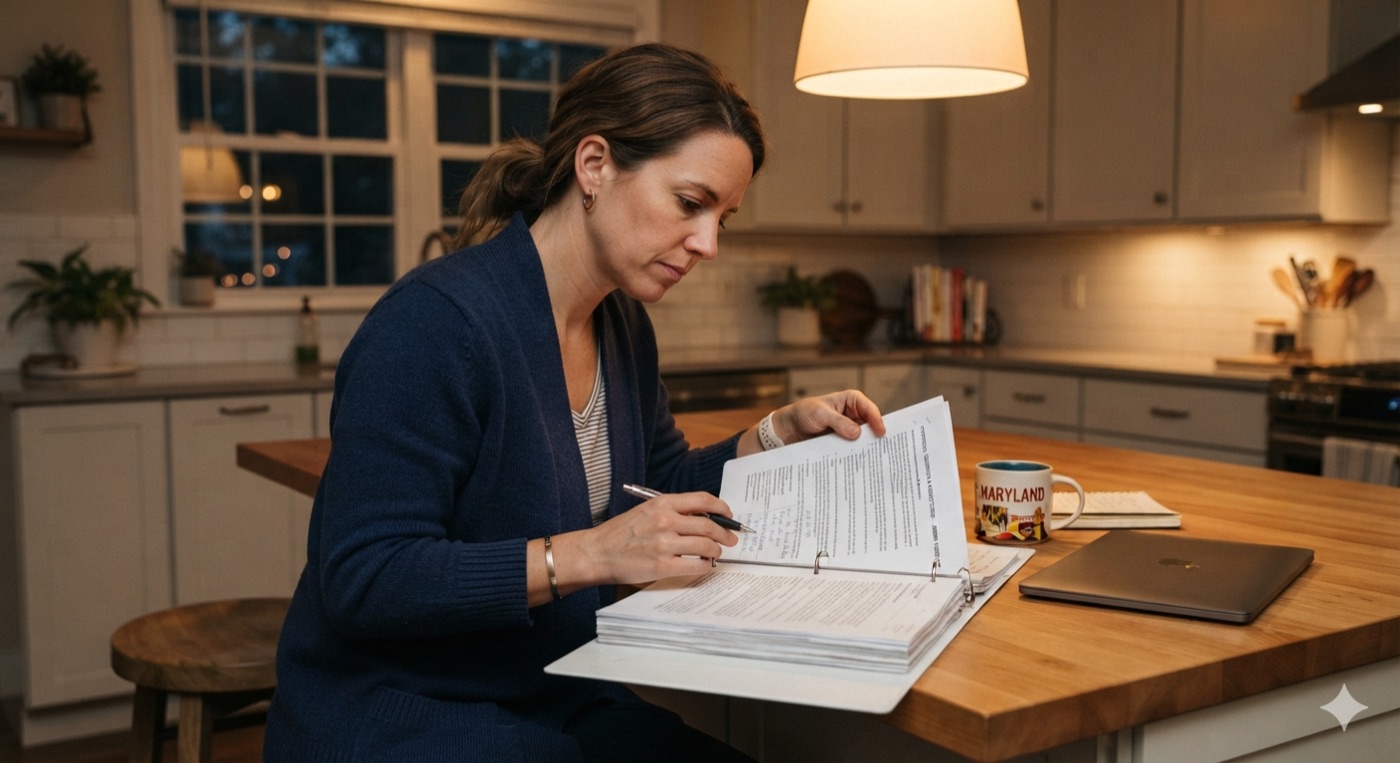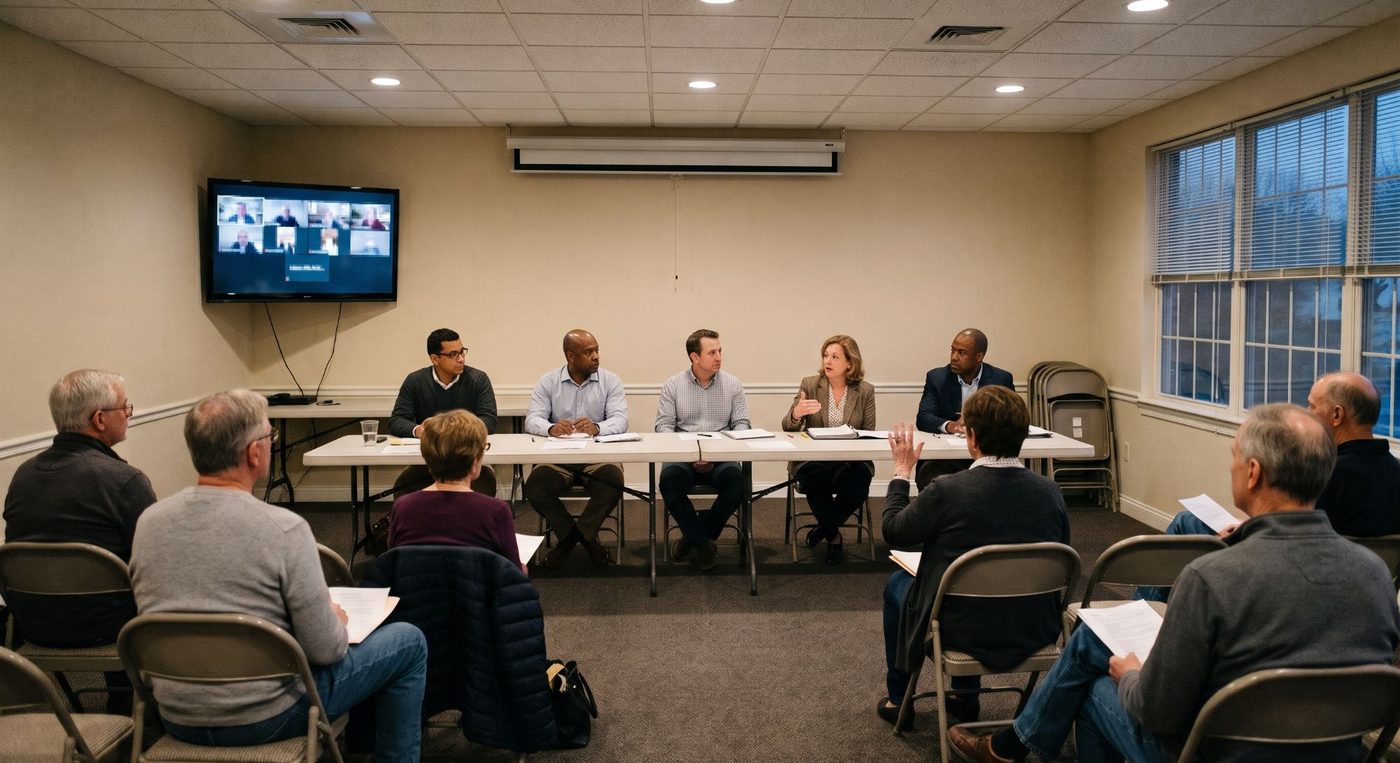
Most volunteer directors learn how to run an HOA board meeting the hard way. You get elected in the spring, inherit a binder nobody has opened since 2009, and chair a room full of your neighbors three weeks later. Nobody hands out a manual. Your governing documents answer part of it, Maryland law answers the rest, and the two rarely show up in the order you need them.
This guide walks the sequence a well-run board meeting actually follows: the meeting types boards use, what the board may decide behind closed doors, how notice and quorum work, how to keep minutes that protect the board rather than expose it, and what the annual meeting requires that a monthly board meeting does not.
The Types of HOA Board Meetings
Maryland associations run four kinds of meetings: the regular open board meeting, the closed or executive session, the annual membership meeting, and the special or emergency meeting called for one defined purpose. Each has a different audience and a different rulebook.
Almost all association business belongs in an open board meeting that members are entitled to attend, and everything else is a narrow, documented exception.
- Regular open board meeting. The working session where the board of directors reviews financials, awards contracts, acts on covenant enforcement, and votes on anything the documents give it authority over. Under the Maryland Homeowners Association Act, all meetings of the association, including board and committee meetings, are open to members or their agents. That last part catches boards off guard: an architectural review committee meeting is a meeting of the association, not a private working group.
- Closed (executive) session. Not a separate meeting so much as a portion of one. The board votes in the open to close the session, handles a limited category of business, then returns to open session to take any action.
- Annual membership meeting. The members’ meeting, not the board’s. Owners elect directors, receive the year’s report, and vote on whatever the declaration and bylaws reserve to them. Notice and quorum rules are stricter than for a regular board meeting.
- Special or emergency meeting. Called between regular board meetings for a stated purpose, usually a bid that cannot wait. When the agenda is limited to specific topics, owner comment may be limited to those topics.
Who may attend is separate from who may speak. Members and their agents may observe, attorneys and contractors attend at the board’s invitation, and only directors vote.
Open vs. Closed Session: What a Board Can Discuss Behind Closed Doors
An HOA closed session is an exception, not a convenience. Maryland enumerates the only purposes that justify closing a board meeting, and any topic outside that list has to be handled in front of the membership no matter how awkward that is.
For homeowners associations, the permitted purposes appear at Maryland Real Property § 11B-111(4). For condominiums, the parallel list sits at § 11-109.1 of the Maryland Condominium Act. The two lists are substantively the same, so a board serving a mixed community can run one procedure for both.
What a Maryland board may close a meeting to discuss
- Matters pertaining to employees and personnel
- Protection of the privacy or reputation of individuals in matters not related to association business
- Consultation with legal counsel on legal matters
- Consultation with staff, consultants, attorneys, board members, or others in connection with pending or potential litigation
- Investigative proceedings concerning possible or actual criminal misconduct
- The terms or conditions of a business transaction in the negotiation stage, if disclosure could adversely affect the association’s economic interests
- Compliance with a constitutional, statutory, or judicially imposed requirement protecting particular matters from public disclosure
- Discussion of individual owner assessment accounts
If the topic is not on that list, the discussion belongs in open session, and closing the board meeting anyway is the most common governance error volunteer boards make. Two procedural rules travel with that list. The board may not take action or discuss a matter in closed session that the statute does not permit. And the minutes of the next meeting must state the time, place, and purpose of the closed meeting, the recorded vote of each board member closing it, and the statutory authority relied on. The vote to close happens on the record, in the open, before the doors shut.
The traps are predictable. A board enters HOA executive session to award a landscaping contract that is no longer in negotiation. Directors hold an unnoticed pre-meeting an hour beforehand and arrive having already decided. A board settles a covenant enforcement matter over email, then ratifies it in thirty seconds. Each moves the decision out of the open board meeting. Condominium boards should also note that nothing in the closed-session statute lets a board withhold the terms of a legal agreement the association is party to. The stakes rose in October 2025, when Chapter 512 of the 2025 Laws of Maryland expanded the Consumer Protection Division of the Attorney General’s Office to enforce violations across both acts, with a current owner counting as a consumer.
Tidewater manages communities across Maryland, Washington DC, Virginia, Pennsylvania, Delaware, and West Virginia, and open-meeting rules differ in each. The sections cited here are Maryland’s, and our Maryland HOA law guide covers Title 11B in more depth.
Notice, Quorum, and the Agenda
A board meeting is only valid if members received proper notice, enough directors are present to act, and the board works from an agenda published in advance. Get those three wrong and every vote taken that night is open to challenge.
Maryland sets no fixed day count for ordinary HOA board meeting notice, so your bylaws are the operative rule. Title 11B requires reasonable notice of all regularly scheduled open meetings and leaves the number to your documents. Condominiums are more specific: a regular or special meeting of the council of unit owners may not be held on less than 10 nor more than 90 days’ written notice to each owner at the roster address. Electronic notice is permitted when the statutory conditions are met.
Quorum is where boards most often improvise. Board quorum comes from your bylaws, membership quorum is a different threshold entirely, and the two get conflated constantly. We covered the math in what quorum is and why it matters, so the short version: confirm it out loud, note it in the minutes, and if you do not have it, adjourn rather than taking votes you will have to redo.
The agenda does more work than boards give it credit for. Publish it with the notice, follow it in order, and keep it short enough that the board meeting ends on time. Maryland requires a designated period for owners to comment on any matter relating to the association, and the governing body must convene at least one meeting each year with an agenda open to any association matter. Put the homeowner open forum at a defined point, set a per-speaker time limit, and let the chair take comments without debating from the table. One note on procedure: Robert’s Rules of Order is a reference, not law. It governs your meetings only if your bylaws adopt it as the parliamentary authority, and even then it yields to statute and your documents.
HOA Meeting Minutes Done Right
HOA meeting minutes are the legal record of what the board decided, not a transcript of what the board discussed. That single distinction governs every judgment call the secretary makes.
Minutes that record decisions defend the board; minutes that record debate hand a future plaintiff a sworn account of who said what. Board meeting minutes are discoverable. A line reading “Director Hall said the contractor had been cutting corners for years” is evidence. A line reading “Motion to terminate the landscaping contract effective March 31 carried 4 to 1” is a decision, and a decision is defensible.
| Include in the minutes | Leave out of the minutes |
|---|---|
| Association name, meeting type, date, time, and location | Narrative of the discussion that led to the decision |
| Directors present and absent, and confirmation of quorum | Named opinions, criticism, or disagreement between directors |
| Approval of the previous meeting’s minutes | Homeowner open forum remarks recorded verbatim |
| Each motion in final wording, the mover and seconder, and the vote result | Personal details about owners, employees, or delinquent accounts |
| Decisions, assignments, and deadlines | Legal advice received from counsel in closed session |
| Closed-session statement: time, place, purpose, recorded vote, statutory authority | Draft language the board considered but did not adopt |
| Time of adjournment and the Secretary’s signature | Anything you would not want read aloud in a deposition |
One rule gets overlooked more than any other: the Board Secretary owns the record even when someone else drafts it. An association manager or a volunteer may type the minutes, but the Secretary reviews and signs them. Delegating the typing is fine. Delegating responsibility for the record is not.
HOA board meeting minutes distribution follows a simple rhythm. The draft circulates to directors within a week or two while memories are fresh, the board approves it by motion at the next board meeting, and that version becomes the official record. Maryland’s records provisions let owners inspect association books and records subject to specific exceptions, and closed-session minutes are among the records a board may withhold unless a majority of a quorum approves unsealing them. Watch the response clock: when an owner asks in writing for minutes or financial statements, the association has 21 days to send them if they were prepared within the last three years, and 45 days if they are older.
Our Board Meeting Toolkit includes a minutes template built on these rules, plus closed session checklists for HOA and condominium boards.
The HOA Annual Meeting and Elections
The HOA annual meeting belongs to the members, not the board. Owners elect directors, receive the year’s financial and operational report, and vote on whatever the declaration and bylaws reserve to the membership. It carries heavier notice and quorum requirements than a regular board meeting, and it is the one meeting a year where a procedural mistake changes who holds office.
Start roughly 90 days out. Condominium boards have specific sequencing to respect: a call for nominations goes to all unit owners not less than 45 days before the election notice is sent, and only nominations made at least 15 days before that notice are listed. HOA calendars still run off the bylaws, but as of October 2025 the bylaws no longer have the last word on how the election itself is conducted.
Maryland now requires elections for an HOA or condominium governing body to be run by independent parties, and governing document provisions that conflict with that requirement are void. An independent party is someone who is not a candidate and has no conflict of interest regarding any candidate. An owner qualifies if they do not electioneer and are not objected to by more than 25 percent of eligible voting members. Associations may also retain a third-party vendor or an election platform, and an owner who conducts an election in good faith is not personally liable for it.
The part that catches boards out: representatives of the association’s management company are not independent parties, unless the association or its parent owns the management company. If your manager has always counted the ballots, that has to change. A manager who raises this before election season, helps the board line up an independent conductor, and then stays out of the count is doing the job correctly.
Proxy rules differ by state and by document type. In Maryland condominiums, an undirected proxy may only be used for quorum purposes and for business other than the election of officers and directors. Publish the proxy form with the notice and set a cutoff for returns.
Plan for a quorum failure before it happens, because the statutory fallback only works if the original notice said the procedure might be invoked. Both Maryland acts allow a second meeting when the first falls short: the original notice must state that the procedure might be used and give the date, time, and place of the additional meeting, a majority of those present must vote to call it, the second meeting happens not less than 15 days later, and separate notice goes out at least 10 days before. The owners present at that meeting constitute a quorum. Skip the advance language and the fallback is gone.
Mid-Atlantic associations tend to hold annual meetings in late winter and early spring, which stacks budget adoption, audit timing, and election prep into one quarter. Map it in the fall and you are not scrambling in February.
Virtual and Hybrid Board Meetings
Maryland lets a board meet by video even when the governing documents say otherwise. Under Real Property § 11B-113.6, the governing body may authorize meetings of the association, the board, or a committee to be conducted or attended by telephone conference, video conference, or similar electronic means, notwithstanding contrary language in the documents. The Condominium Act carries a parallel provision.
Three conditions decide whether a virtual board meeting holds up. The equipment has to let every participant hear and be heard by all the others, so a one-way stream is not a meeting. The notice has to include the link or the instructions for joining. And anyone attending electronically is deemed present for quorum and voting, which means you cannot treat remote directors as observers or leave them out of the count.
A few details boards get wrong at a hybrid board meeting. Only owners actually present during the electronic meeting may vote a ballot at it, while absent owners vote by proxy and count toward quorum through that proxy. The board may set a reasonable deadline for returning ballots, including by electronic transmission. And if an owner cannot connect because of trouble with their own phone or computer, that does not invalidate the meeting or anything decided at it.
One provision pays off at election time. Where your documents require nominations from the floor, that requirement does not apply if at least one candidate has already been nominated for every open seat.
Frequently Asked Questions
When should HOA meeting minutes be distributed?
Draft minutes should circulate to the board within one to two weeks, and the version the board adopts by motion at the next board meeting becomes the official record. Many associations then post it to the owner portal. In Maryland, an owner who requests minutes in writing must receive them within 21 days if they were prepared in the last three years, or within 45 days if they are older, so treat approved open-session minutes as something the membership will read.
Is it legal to record an HOA meeting?
Recording an open meeting is generally permissible, subject to your association’s rules and your state’s recording laws. Many boards adopt a written policy allowing it with advance notice to the chair, which keeps the question from being argued in the moment. Closed sessions are different, since a recording undermines the confidentiality the statute protects.
Are HOA meeting minutes public record?
Association minutes are an association record owners can typically access, not a government public record in the sense that term usually carries. Maryland’s records provisions give owners the right to inspect association books and records, with specific exceptions. Closed-session minutes are among the records a board may withhold unless a majority of a quorum votes to release them.
What can an HOA board discuss in closed session?
Only the narrow categories the statute allows: personnel matters, individual privacy or reputation, legal consultation, pending or potential litigation, investigations of possible criminal misconduct, business transactions still in negotiation, legal confidentiality requirements, and individual owner assessment accounts. The board must vote in open session to close the meeting, and the next meeting’s minutes must record the purpose, the vote of each member, and the statutory authority relied on.
Who can vote at an HOA board meeting?
Only directors vote on board business at a board meeting. Owners who attend may observe and speak during the designated comment period, but they do not vote. Member voting happens at the annual meeting or a special membership meeting, on matters the bylaws reserve to the membership, such as electing directors.
Running a Board Meeting Your Community Can Trust
Knowing how to run an HOA board meeting is mostly a matter of sequence: notice that satisfies your documents, a confirmed quorum, a published agenda, business conducted in the open, closed session only for the purposes the statute names, and minutes that record decisions rather than conversation. Get that rhythm right and the pressure on a volunteer board drops noticeably.
Tidewater’s PCAM-credentialed association managers attend and support board meetings, keep agendas, minutes, and governing documents in the CINC board portal, and track management plan deadlines so nothing reaches a board meeting as a surprise. Our Quality Assurance team monitors those deadlines across every community we manage.
Give your board a meeting process it does not have to rebuild every quarter.
Download the Board Meeting Toolkit for the minutes template and closed session checklists, or request a proposal to see what hands-on association management looks like in your community.
Request your association management proposal →